

Tamarin • Togo
Improved cookstoves
Distributing 150,000 improved cookstoves in rural Togo to reduce wood consumption and indoor pollution.
Read details



Phase 1 compliance is closer than it looks. Airlines are expected to need around 200-250 million CORSIA-eligible emissions units (EEUs) to cover 2024 to 2026 (IATA, September 2026), and those units must be bought and cancelled by January 2028. But the constraint isn’t mainly demand or budget. It’s supply, and the reason is that relatively few host countries have issued the letters of authorisation (LoAs) that make a credit CORSIA-eligible in the first place.
In this article: where the phases stand, why supply is tightening, and what it means for buyers.
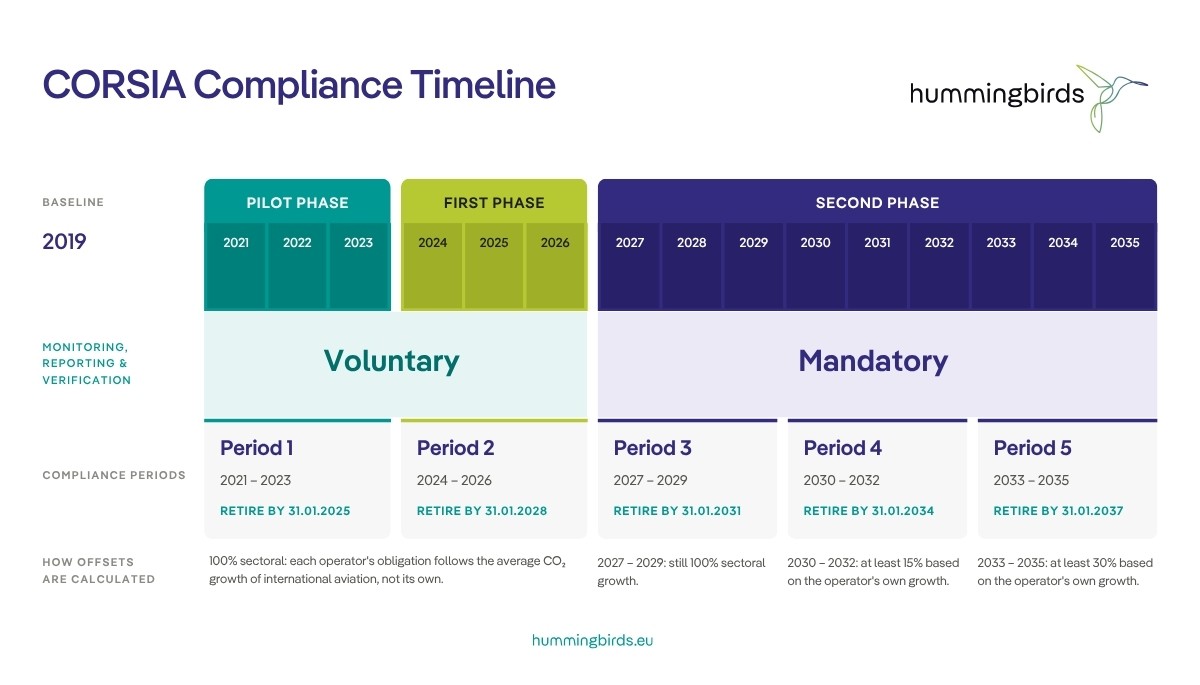
International flying keeps growing, and so do its emissions. CORSIA, ICAO’s Carbon Offsetting and Reduction Scheme for International Aviation, was created to hold the sector’s net CO2 to a fixed baseline. Fly above it and you make up the difference, by buying CORSIA-eligible emissions units (EEUs), by using CORSIA-eligible fuels (CEFs), or by a combination of the two. Airlines report their emissions annually, but they settle in blocks: the whole 2024 to 2026 period has to be covered by units cancelled by January 2028.
The three CORSIA phases
A credit doesn’t become CORSIA-eligible just because it comes from an approved programme. The host country where the project sits must issue a letter of authorisation and apply a Corresponding Adjustment to its own Nationally Determined Contributions (NDCs), so the reduction is counted once: towards the airline’s CORSIA obligation, and not towards the host country’s own climate target. Authorising units means a government hands over emissions reductions it could otherwise count towards its own climate target, and most countries are still working through what they are willing to release and under which framework.
The gap is easy to quantify. IATA puts Phase 1 demand at 200 to 250 million units by January 2028. As of August 2026, roughly 42 million units sat behind the CORSIA-compatible LoAs issued so far, and that number already counts volume verified but not yet issued. Guyana was first to market in February 2024 with almost 25 millions units issued to date, and by April 2026 IATA counted ten host countries that had released supply through an LoA, among them Rwanda, Tanzania and Laos. That leaves a gap of around 150 to 200 million units, and roughly fifteen months to close it.
This is the part buyers tend to underestimate. An authorised unit requires a registered project under an ICAO-approved programme, an eligible methodology and vintage, verified reductions, a host-country LoA, and an arrangement with an insurance provider covering the risk of a Corresponding Adjustment being revoked. Two clocks run at once. The first is technical: for a new carbon project, it typically takes at least two years from launch to first credit issuance, covering design, validation, implementation, monitoring and verification – sometimes a bit less for clean cooking projects, often much more for nature-based projects. The second is administrative: registration, eligibility confirmation and the LoA each follow their own timetable, and the LoA usually waits on a government finalising its Article 6 framework first. Supply only reaches the market once both tracks are complete, and neither compresses into a quarter because demand spiked.
The strain is already showing in policy. The European Commission dropped its additional quality criteria for Phase 1 this year in response to the shortfall, while keeping the tougher requirements for Phase 2.
Price is the visible symptom. Early Phase 1 trades settled around €19 per tonne, and market modelling puts 2027 in the €23 to €33 range under base-case supply, above €55 if supply stays constrained. But price isn’t the binding constraint for most buyers. Availability is. You can have budget signed off and still not find authorised volume that clears your eligibility screen.
And the supply that does exist isn’t interchangeable. Eligibility is decided credit by credit: programme, methodology, vintage, project type, and the LoA sitting behind it. A unit that passes one airline’s screen can fail another’s. Phase 1 approval doesn’t automatically carry into Phase 2 either, notably due to vintage eligibility, so volume that solves this compliance period may not solve the next.
The best course of action
Waiting carries an obvious cost and a less obvious one. The obvious one is price: a market 150 million units short against a fixed deadline only moves in one direction. The less obvious one is choice. Buyers arriving in 2027 will be picking from what’s left rather than what fits, and by then Phase 2 demand is stacking on top of unsettled Phase 1 obligations. Airlines that close out their Phase 1 position early aren’t only buying cheaper. They’re buying with options.
hummingbirds is a B Corp-certified, DFI-backed developer of nature-based carbon projects across Africa, Latin America and Southeast Asia, from design through issuance. We work with host governments on authorisation and hold the eligibility documentation ourselves rather than passing it along a chain of intermediaries. When you ask about registry status, methodology, vintage or where an LoA genuinely stands, the answer comes from the people managing the process. Our pipeline includes improved cookstove programmes with host-country authorisation under way and volume that can be contracted forward ahead of issuance. We can tell you precisely where each one sits.
Planning your CORSIA-eligible volume for Phase 1, or already looking at Phase 2? Let’s talk about what’s available now and what’s realistically coming through the pipeline.