

Label bas-carbone • France
Afforestation/Reforestation
Our LBC projects span 400 hectares in different regions of France to improve the climate resilience of French forests.
Read details


Across France, millions of hectares of land sit in private hands. For many owners, for instance retirees who no longer farm, families who inherited land they are unsure what to do with, individuals who cannot afford the cost of maintaining it, the question of what comes next has no obvious answer. The Label bas-carbone offers one.
Created by France’s Ministère de la Transition Écologique in 2018, the Label bas-carbone is France’s national carbon certification framework, designed to support the country’s long-term greenhouse gas reduction commitments by facilitating the financing of emissions reduction and sequestration projects. It covers multiple sectors, such as agriculture, buildings, transport, and marine ecosystems.
Projects are assessed against five fundamental criteria: uniqueness, measurability, verifiability, permanence, and additionality. Carbon credits are calculated as the measurable difference between what a project achieves and what would have happened without it. In the case of an afforestation project on previously unforested land, that means the difference between the carbon sequestered by the new forest and the baseline of the land as it was. Independent auditors verify compliance, and regional environmental authorities are responsible for labelling and verifying projects, ensuring oversight is grounded at the territorial level.
For landowners, the model works as follows: they commit to planting and managing their land over a 30-year period. Credits are issued and verified at year 5, after audit and validation. The revenue from those credits reimburses the cost of planting and covers the maintenance to come. Ownership does not change hands: the land stays theirs, and so does the decision about what it becomes.
You can find out more about the Label bas-carbone framework here.
hummingbirds works with over 50 Label bas-carbone forestry projects across France.
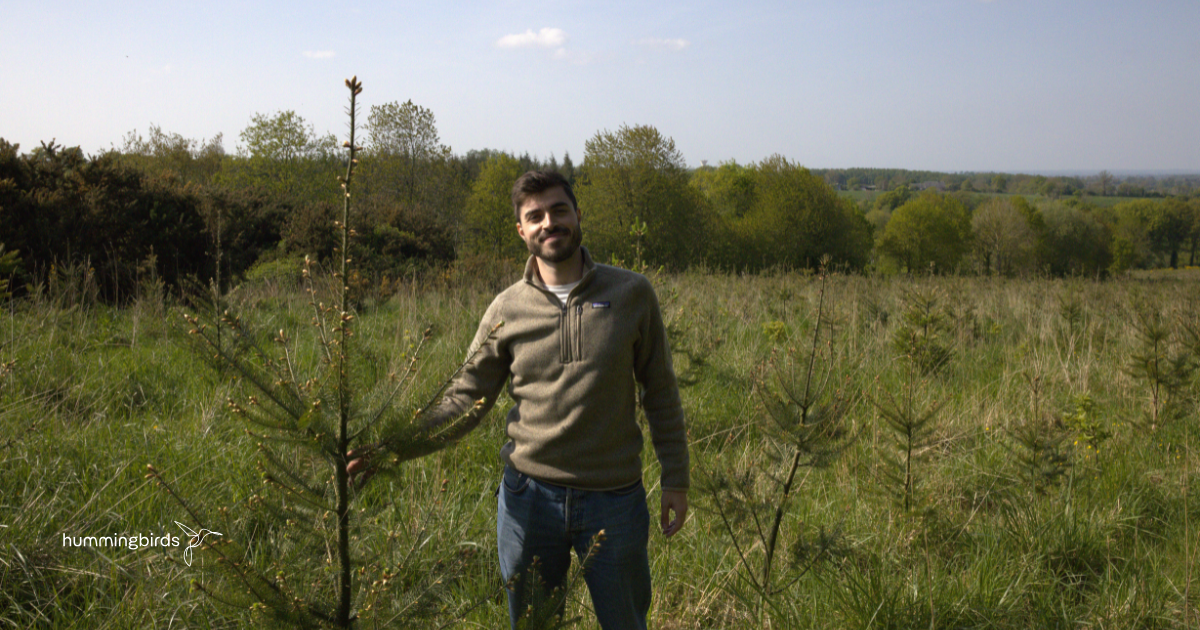
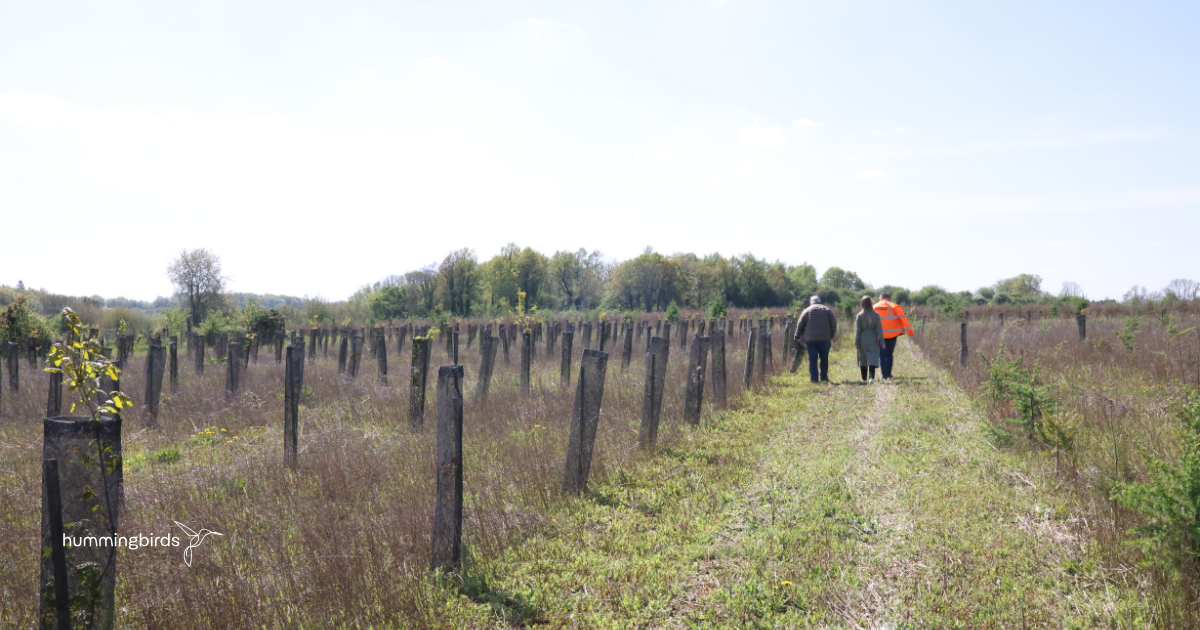
Recently, our team visited two of them in Normandy — in La Ferté-en-Ouche and in Cérences — to meet the landowners and foresters managing them.
In Cérences, our afforestation project introduced 9 different tree species: sessile oak, wild service tree, european hornbeam, black locust, sycamore maple, douglas fir, sweet chestnut, loblolly pine, and downy oak. For context, a large part of afforestation projects optimise for simplicity, two or three species, predictable management costs, and faster carbon accounting. Nine species is a deliberate departure from that logic. Different root architectures, different canopy structures, different ecological relationships with soil composition, insect populations, and local fauna: the result is a forest built for resilience rather than throughput, one that will function as a genuinely complex ecosystem decades from now.
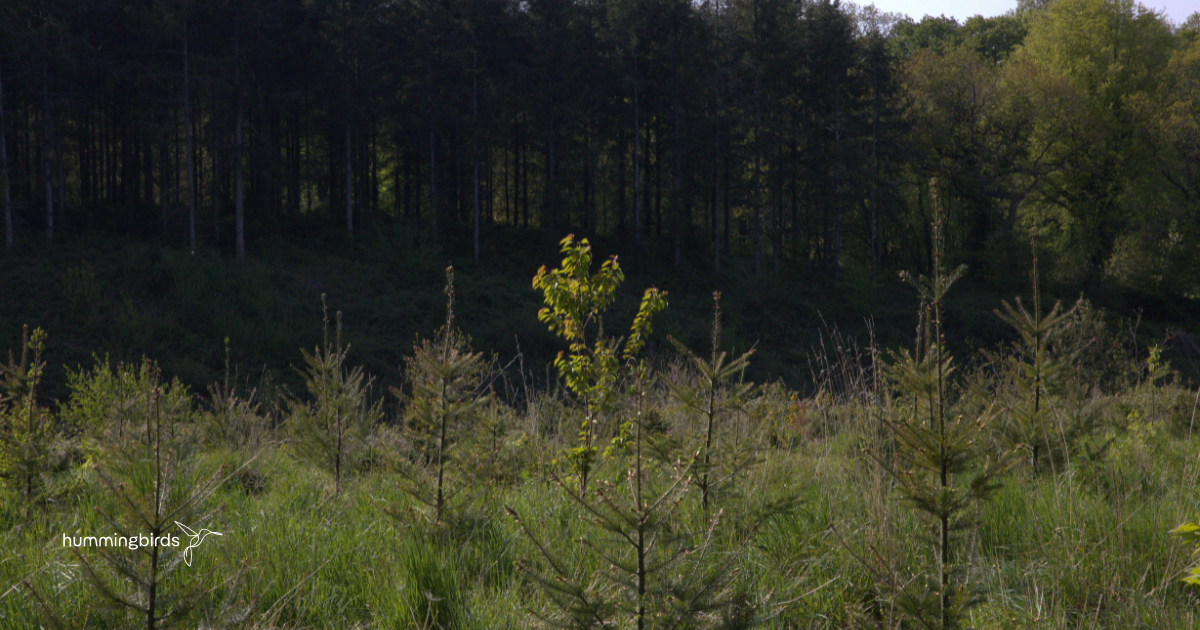
Besides label-bas carbone, the project is PEFC certified, which ensures that forests are managed in a way that protect biodiversity and wildlife, maintain forest health and regeneration, and support sustainable timber production.
The project rolls out around forest ecosystemic services: native species diversity preservation of wooded borders and soil minimal preparation allow for erosion control, fertility improvement, and soil preservation, which will ultimately reinforce the resilience of the forest.
That kind of thinking does not emerge from a spreadsheet. It reflects a landowner who has a specific vision for what his land should become, and a Label bas-carbone structure that gives him the financial means to pursue it without compromising ownership or long-term control.
Our 7 ha afforestation project in La Ferté-en-Ouche shares the same approach. For the landowner, the key-rationale to use the label bas-carbone is ownership and legacy, before carbon sequestration. Specifically, his main concern is what his land will look like in 50 years, and who would be walking through it.
“Grâce au LBC, j’ai pu garder cette terre.”
Thanks to the LBC, I was able to keep this land.
“Je le donnerai à mes enfants, et j’espère qu’eux le donneront à leurs enfants.”
I’ll pass it on to my children, and I hope they’ll pass it on to theirs.
“Un jour [cette parcelle] deviendra comme la forêt à côté.”
One day [this plot] will become like the forest next door.
The last line is striking not for its ambition, but for its patience. In France, there are more than 3,5 million private forest landowners, with average plot sizes of just 2 ha. For most, their forest is a family inheritance, a patrimony to preserve and pass on. They think in terms of generation and transmission, not reporting cycles.
We believe that this attachment is a powerful lever for caring of the French forest, piece by piece. We are proud to engage with individuals who are committed to treating their land with the same care they would show to a member of their own family.
The voluntary carbon market gives companies a genuine choice about where their climate investment goes and what it supports. For companies with operations in France, Label bas-carbone forestry projects offer something that most carbon products cannot: a direct, visible connection between investment and impact on the ground, in a region the company knows and operates in.
When a business based in Normandy supports a project like La Ferté-en-Ouche or Cérences, the investment funds something geographically specific; a named landowner, a mapped piece of land, a forest growing in the same territory where that company’s teams work and its stakeholders live. That proximity is a straightforward consequence of how the Label bas-carbone is structured: projects are locally rooted and built to last.
The numbers behind a Label bas-carbone project only tell part of the story. The verification frameworks matter, the additionality tests matter, the permanence requirements matter. So does the person behind the project.
With over 50 Label bas-carbone forestry projects spread across France (across Normandy, Brittany, the Loire Valley, the Massif Central, the Southwest and beyond) there is likely a project close to where your operations or your customers are. If you want to understand which Label bas-carbone projects would best fit your organisation’s geography and philosophy, if you’re keen to discuss with landowners involved into forestry projects, speak to our team: