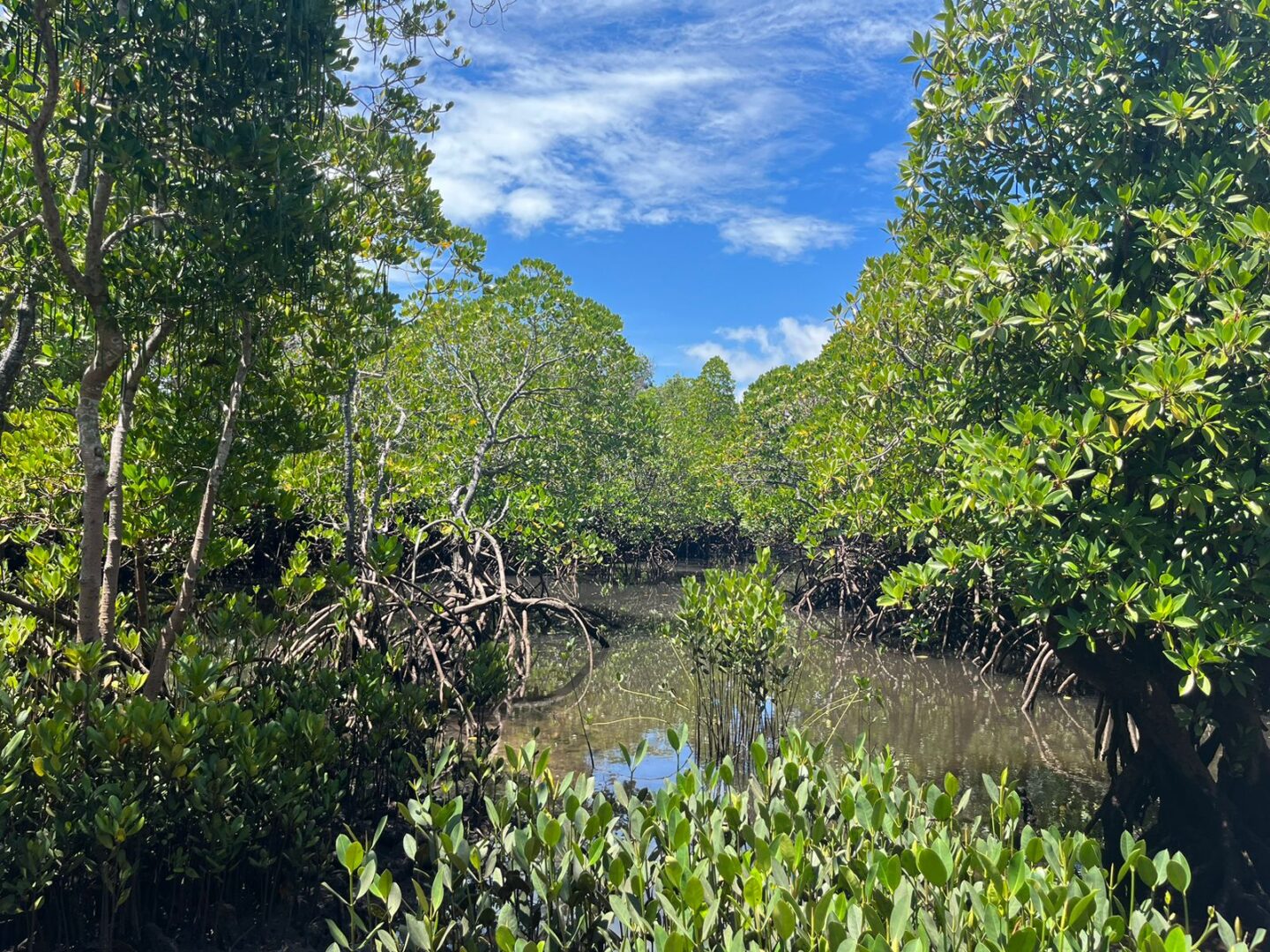
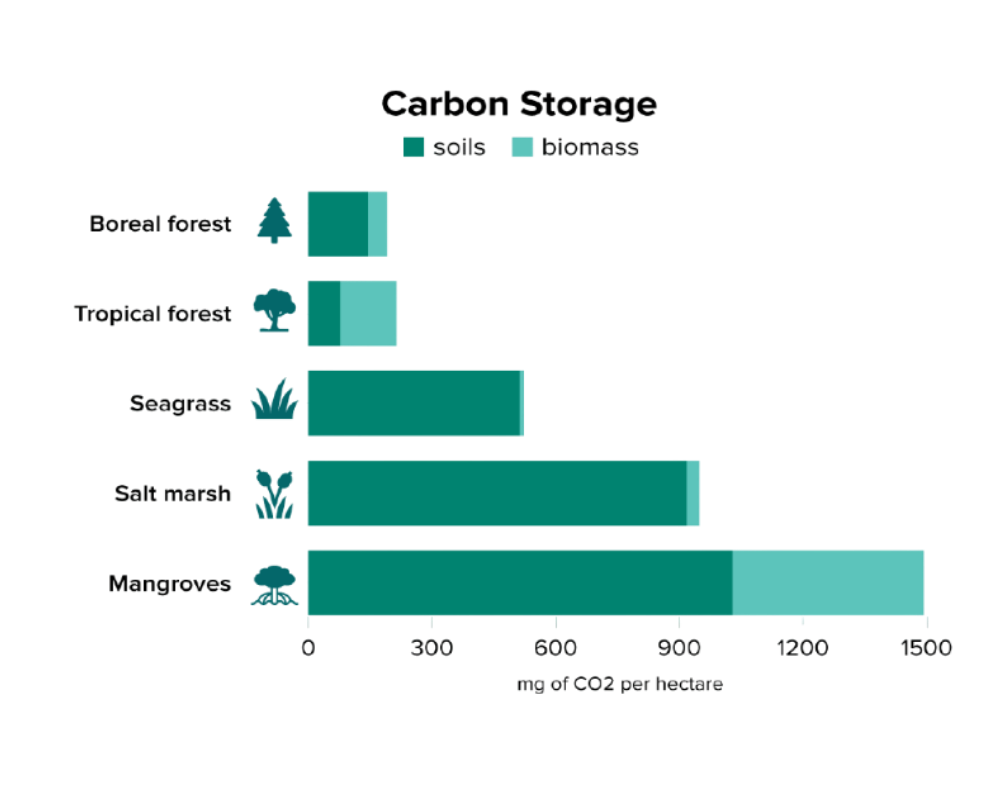
When we talk about climate solutions, forests tend to steal the spotlight. But some of the most powerful natural carbon sinks on the planet are not found on land, but along our coasts. Blue carbon ecosystems such as mangroves, seagrasses, and salt marshes store more carbon per hectare that far exceed most terrestrial forests.
Mangroves fringe tropical and subtropical shores from Southeast Asia to West Africa and Latin America, while seagrass meadows and salt marshes stretch across temperate and even sub‑Arctic regions. This wide but patchy distribution means conservation and restoration efforts must be tailored to local ecological and cultural contexts.
Despite their powerful role in climate mitigation and the intense attention around “blue carbon”, this type of project has a surprisingly small share of the Voluntary Carbon Market (VCM). Today (April 2026), only 19 wetland restoration projects are formally registered, and credit issuance remains very modest compared with other NbS project types: less than 20 million credits out of the 916 million NbS credits ever issued. This creates a gap between market perception and actual supply, and it is important for anyone working in the sector to understand the real landscape.
Blue carbon ecosystems are climate powerhouses, biodiversity havens, and natural shields against storms and erosion. Although they cover less than 2% of the ocean floor, they account for up to 50% of the carbon stored in marine sediments. Mangroves, in particular, are extraordinary:
In short, the conservation and restoration of mangroves deliver mitigation, adaptation, and resilience all at once.
Despite their potential, blue carbon ecosystems are very complex and come with scientific and methodological challenges, complicating their integration into carbon markets.
Most of the carbon in mangroves is stored below ground, often several meters deep. Sampling, analyzing, and modeling this carbon requires specialized methods, especially in mangrove ecosystems. Soil depth, sediment composition, hydrology, and root structure can vary dramatically from site to site, meaning that carbon stocks cannot be assumed or generalized. Each project demands tailored field sampling protocols, costly laboratory analysis, and site‑specific modeling to accurately quantify total carbon and its long‑term stability. Another layer of complexity comes from allochthonous carbon, organic material that originates outside the ecosystem and is transported into mangroves by tides, rivers, or coastal currents. Unlike autochthonous carbon, which is produced by the ecosystem itself, allochthonous inputs can inflate soil carbon stocks without necessarily reflecting the ecosystem’s own sequestration capacity. Distinguishing between these two carbon sources is scientifically challenging, yet essential for credible carbon accounting, as methodologies must ensure that credited carbon reflects real, additional climate benefits rather than natural sediment deposition.
Sea‑level rise adds another layer of complexity. As water levels increase due to climate change, mangrove systems can either expand inland or drown in place, depending on local topography and sediment supply. Rising seas can enhance carbon burial in some areas by increasing sediment deposition, but they can also accelerate erosion, stripping away centuries of stored carbon and turning long‑term sinks into sudden sources. Hydrological shifts, whether from sea‑level rise, altered tidal regimes, or upstream water management, can reshape the balance between sedimentation and erosion. Because erosion can rapidly mobilize large amounts of previously stable soil carbon, robust monitoring of shoreline changes as well as modelling and measuring hydrodynamics is essential for successful blue carbon projects.
Mangroves are exceptionally efficient carbon sinks, but their long‑term stability is far from guaranteed. These ecosystems sit at the frontline of climate change, exposed to cyclones, tsunamis, storm surges, coastal erosion, and accelerating sea‑level rise. Extreme weather events can uproot trees, erode shorelines, and mobilize large quantities of carbon that had been locked away in soils for centuries. In some cases, a single cyclone can reverse years of removal gains.
Ensuring permanence in blue carbon projects therefore requires more than planting trees. It demands continuous monitoring, adaptive management, and robust risk‑mitigation strategies that account for both climatic and anthropogenic threats. Only by understanding and planning for these vulnerabilities can blue carbon projects deliver durable climate benefits.
To address the growing understanding of the complexities of blue carbon ecosystems, new methodologies have been developed and launched by carbon standards within the past years.
As mentioned, blue carbon ecosystems sit at the intersection of climate mitigation, biodiversity conservation, and coastal resilience. Their potential is extraordinary, but unlocking it requires scientific rigor, strong partnerships with coastal communities, long‑term stewardship, and methodologies that reflect the true complexity of coastal systems. As climate science and measurement methods improve, carbon accounting frameworks must evolve to ensure every credit represents a real, lasting climate benefit.
At hummingbirds, we are committed to enabling and supporting the development of high-quality and high-integrity Blue Carbon projects, combining ecological impact with community‑driven stewardship. One example is our Papariko project in Kenya, a community‑based mangrove restoration project that demonstrates how restoration can strengthen local livelihoods while safeguarding an ecosystem with strong capacity to remove carbon. This type of project shows what is possible when science, local knowledge, and long‑term commitment come together.
Papariko was the first mangrove restoration project to be registered at Verra with CCB and SDVista co-certification labels. The first carbon credits from the project are expected to be issued in 2026, as verification is currently undergoing.
If you are developing a mangrove restoration or conservation project and are exploring opportunities for high‑quality carbon certification or long‑term implementation partnerships, we would love to connect. Our team is constantly seeking credible, impact‑driven collaborators working in mangrove ecosystems, and we welcome you to reach out to discuss potential alignment and next steps.