
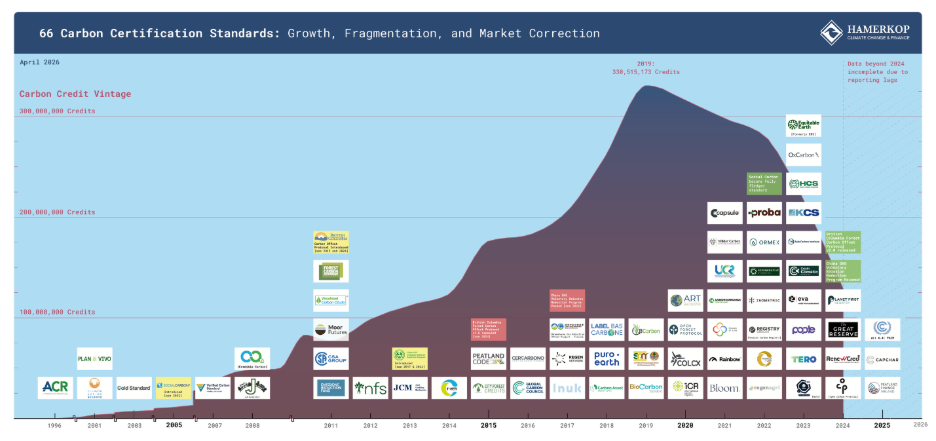
If you follow the Voluntary Carbon Market, you’ve likely noticed the explosion of new carbon standards over the past few years. In June 2026, Hamerkop counted 66 carbon standards in total. This represents an exponential increase since 2020, as shown in the graph published by Hamerkop.
When we see so many standards in the market, with new ones launching regularly, we ultimately ask ourselves: which one should we choose?
The answer is quite complex as it involves several factors. Here’s how we answer that at hummingbirds.
Before comparing the standards head-to-head, the first step is to get an overview of the available methodologies for certain types of projects. Given that some standards don’t certify specific types of projects, we first need to screen the overall market and see which ones are available.
A few examples:
For us at hummingbirds, it’s essential to follow strict, reliable, transparent and scientific methodologies to issue credits that genuinely represent 1 tCO2e removed or avoided. So, after shortlisting the potential methodologies, we evaluate how good they are. This means asking:
The market has moved toward stronger methodologies in recent years, and the clearest signal of that shift is the CCP (Core Carbon Principles) label. Developed by the ICVCM (Integrity Council for the Voluntary Carbon Market), the CCP evaluates the quality of standards and methodologies, ensuring their approach is conservative and realistic. So far, the CCP has assessed and approved 43 methodologies, including ARR, IFM, REDD+, blue carbon, and cookstoves, among others. You can find the full list on the ICVCM website.
Another important factor when selecting methodologies and standards is buyer appetite and acceptance. This is where the commercial lens comes in:
As carbon credits are the primary revenue source for most VCM projects, this criterion is important. It’s a direct input into the project’s financial viability.
Another factor worth weighing is the certification process itself. Most new standards position themselves as much faster than the established ones – one of their key selling points. And it’s true that the faster you issue credits, the faster you see financial returns, making the project more attractive. On the other hand, some of these newer standards also charge higher prices, which can significantly affect the project’s business plan.
The right choice depends on balancing time-to-issuance against the cost of certification for that specific project.
Many factors influence the selection of the most appropriate standard and methodology: project typology, location, market acceptance, scientific soundness, certification costs, credit prices, time taken to issue credits. Indeed, the list can be very long. There’s rarely one standard that wins on every axis; the job is finding the best trade-off for the specific project in front of you.
If you’d like support with methodology and standard selection for your project, hummingbirds can help. With years of experience in carbon certification, we help project developers and buyers understand the market opportunities and identify the best options for certifying NbS (Nature-based Solutions) projects.
Reach out at hello@hummingbirds.eu to learn more.