
Sapucaia • Brazil
Afforestation / Reforestation
Through regenerative forestry and agroforestry, the Sapucaia project will restore 10,000 hectares while expanding habitat for the endangered Golden Lion Tamarin.
Read details



In the field of carbon markets, forests (and particularly trees) hold a central place. This importance stems both from their role in the carbon cycle and from the fact that a portion of their biomass can be measured in a standardized way.
However, carbon is not distributed evenly across a forest, since soils hold approximately 46% of the global forest carbon stock, living biomass (above and below-ground) accounts for about 44%, and litter and dead wood for the remaining 10%. Within living biomass, above-ground components (trunks, branches, and foliage) represent close to 79% of the total1.
Yet, while soils are a major carbon reservoir, their measurement remains complex and difficult to standardize at large scales. Living biomass, by contrast, can be estimated more directly through forest inventories, allometric equations2, and remote sensing.
This measurement capacity explains the significant weight of forest projects in the voluntary carbon market. In 2025, forestry and land use accounted for 37% of carbon credit retirements, of which 25% were from REDD+ projects3. But this focus on measurable stocks comes at a cost. As carbon accounting struggles to integrate broader ecological functions, biodiversity is most often reduced to a co-benefit.
A carbon stock can look identical on paper whether it stems from an intact ecosystem, a degraded one being restored, or fragmented habitats reconnected through corridors. Yet these starting points describe very different ecological realities, and rebuilding the conditions for biodiversity to return is not the same task as protecting what is already there. A shift is therefore required to look at the forest as an ecosystem rather than a stock.
Understory vegetation, which includes seedlings, shrubs, herbaceous plants, mosses, lichens, and lianas, forms a distinct stratum of the forest that plays a structural role of its own within the ecosystem. It supports natural regeneration, and drives nutrient cycling, while also helping conserve water in forest soils and mitigating greenhouse gas emissions through carbon and nitrogen dynamics. Beyond these functions, it provides food, shelter, and habitat for a wide range of animal species, from soil arthropods to large herbivores4.
Despite these contributions, this stratum is often perceived as a nuisance rather than an asset, since it competes with commercially valuable trees for light, water, and nutrients. This perception, combined with the fact that understory vegetation remains largely invisible to carbon accounting methodologies, means its ecological value is rarely reflected in how forests are managed or measured. This holds true even under certification schemes such as FSC, which govern management practices but do not address carbon measurement protocols.
Neglecting the understory comes at a cost, even from a carbon-focused perspective, as more diverse plant communities tend to produce and sustain more biomass over time. A global loss of plant diversity could thus reduce ecosystems’ capacity to store carbon5. What looks like an ecological blind spot, may ultimately undermine the very carbon function forest projects are meant to deliver.
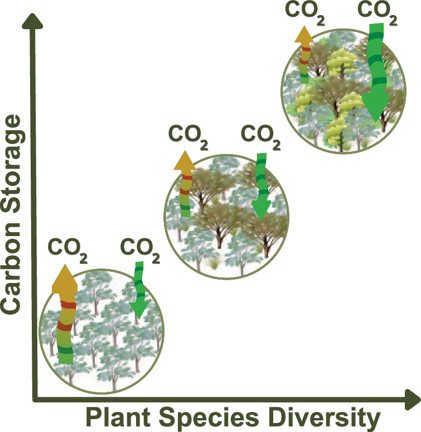
Forest plots with greater plant species diversity tend to store more carbon, illustrating why a loss of plant diversity can directly undermine a forest’s carbon function not just its ecological value.
Source: Weiskopf, S.R. et al. Biodiversity loss reduces global terrestrial carbon storage. Nature Communications 15, 4354 (2024). https://doi.org/10.1038/s41467-024-47872-7. Licensed under CC BY 4.0.
If understory vegetation remains imperfectly captured by carbon tools, fauna represents an even larger blind spot, as animals are mobile and not always present where and when they are surveyed, meaning that even well-designed monitoring tends to undercount them6.
Yet fauna plays a central ecological role too, participating in seed dispersal, pollination, nutrient cycling, and the structuring of plant communities. Large frugivores illustrate this well, as large-seeded trees that depend on animals for dispersal often make sizeable contributions to overall forest biomass. When these frugivores disappear, tree regeneration is disrupted and the forest’s carbon storage potential diminishes as a result, with defaunation estimated to reduce carbon storage by 0–26% in tropical regions, primarily through the decline of these species7,8.
This dynamic points to a deeper limitation in how forests are currently valued for carbon. A forest can retain its tree cover and be counted as a stable carbon stock even as the animal interactions sustaining it quietly unravel. Far from a mere co-benefit, wild animals are a core component of natural climate solutions9.
Given these limitations, it is worth asking whether carbon standards themselves have started to account for them. Several frameworks now incorporate environmental safeguards, along with requirements related to non-invasive species habitat quality, or ecosystem impacts:
Biodiversity benefits are thus still largely treated as co-benefits additional to climate impact.
Biodiversity is increasingly recognized in carbon standards through safeguards, habitat requirements and co-benefit frameworks, but what these commitments mean in practice depends heavily on the starting point of the project. Protecting an existing forest, as REDD+ does, is a fundamentally different task from rebuilding vegetation and ecosystem functions over time, as ARR sets out to do.
One of the REDD+ safeguards requires that activities remain consistent with the conservation of natural forests and biological diversity, rather than being used to convert them10. This reflects the underlying logic of REDD+ itself: since the aim is to protect existing forests and their carbon stocks, the biodiversity they already contain is meant to be preserved in the process. The challenge here is therefore to maintain it, ensuring that forest protection genuinely holds up over time. ARR activities reverse this logic, since they often start from degraded land, cleared areas or landscapes where ecological functions have been partially lost. However, not all ARR projects share the same objective. Some are oriented toward ecological restoration using native species, others toward commercial timber production, and others toward agroforestry, which integrates trees into agricultural systems and can deliver a mix of production and ecological benefits11,12. For projects pursuing ecological restoration, the biodiversity challenge is not only to avoid further loss but to enable biodiversity to return over time, a process that restoration does not achieve immediately, as recovering ecosystems still show annual deficits of 46–51% in organism abundance and 27–33% in species diversity compared with undisturbed reference sites, alongside remaining deficits of 32–42% in carbon cycling, which makes monitoring harder than tracking tree growth alone13,14.
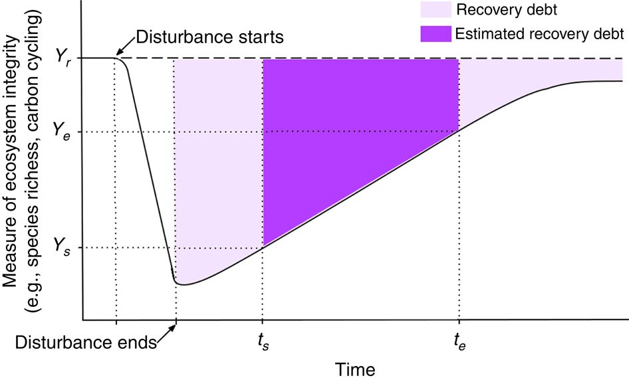
After a disturbance, ecosystem integrity (species richness, organism abundance, carbon cycling) drops sharply and only recovers gradually. The shaded area represents the “recovery debt,” the cumulative shortfall compared with an undisturbed reference site. It shows why restored ecosystems can take decades to catch up, even once tree cover seems to be fully recovered.
Source : Moreno-Mateos, D. et al. Anthropogenic ecosystem disturbance and the recovery debt. Nature Communications 8, 14163 (2017). https://doi.org/10.1038/ncomms14163. Licensed under CC BY 4.0.
Carbon accounting cannot capture biodiversity, but several pathways can help bring ecological integrity closer to the core of forest carbon projects.
Standards themselves are moving in this direction, as the ICVCM’s Core Carbon Principles now require that mitigation activities do not come at the expense of ecosystems: habitats of rare and threatened species must be protected, connectivity preserved, and high-conservation-value habitats left unconverted. For forest carbon projects, credibility increasingly depends on protecting biodiversity, not just quantifying tonnes of CO2e.
Market demand is reinforcing this shift, as buyers grow more attentive to the credibility of a project than to the number of tonnes of CO2e it claims. Wildlife in particular has become a strong selling point, with buyers increasingly drawn to projects that can demonstrate thriving animal populations alongside carbon outcomes. Yet claiming this kind of result convincingly requires tracking the full chain, from vegetation structure to species abundance to the ecological interactions that sustain them. This is precisely where strong safeguards, such as delivering net positive outcomes, become a factor of differentiation between projects.
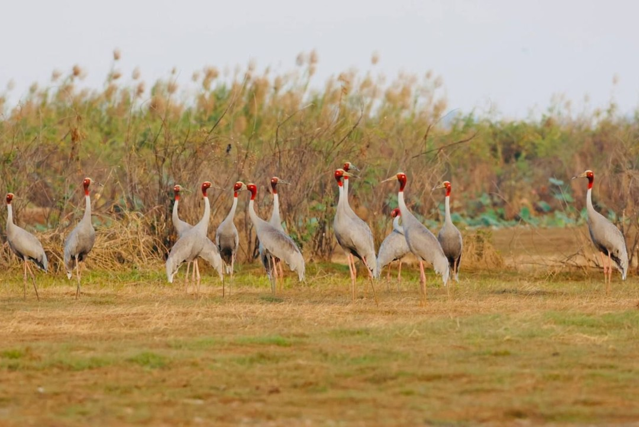
At hummingbirds, we are committed to enabling and supporting the development of high-quality and high-integrity forest projects and striving for biodiversity consideration within project design and implementation. One example is our Lomphat conservation project in Cambodia. In partnership with BirdLife International and NatureLife Cambodia, the Lomphat Wildlife Sanctuary covers 127,270 hectares of forest in the Ratanakiri and Mondulkiri provinces. The project is expected to avoid 8.8 million tCO2e over 40 years while safeguarding habitat for 43 globally threatened species, including the giant ibis, the sarus crane, and the red-headed vulture.
Beyond carbon, Lomphat illustrates the challenge of maintaining biodiversity. Indeed, the biodiversity conservation component of the project includes ranger patrols and the establishment Community Protected Areas (CPAs) and community-based organisations (CBOs) for conservation management initiatives, to face biodiversity threats such as overhunting and poaching. It also includes strong monitoring efforts to assess the effectiveness of conservation of flagship species. In 2025, conservation efforts translated into 5,191 hectares under community-based co-management and a 214% increase in the sarus crane population since 2022.
1FAO: Key findings | Global Forest Resources Assessment 2025
https://openknowledge.fao.org/server/api/core/bitstreams/2dee6e93-1988-4659-aa89-30dd20b43b15/content/FRA-2025/key-findings.html
2Nature Index: Allometric Models for Biomass Estimation in Forest Ecosystems
https://www.nature.com/nature-index/topics/l4/allometric-models-for-biomass-estimation-in-forest-ecosystems
3Sylvera, 2025: Forest carbon credits
https://www.sylvera.com/blog/forest-carbon-credits
4Deng et al., 2023: Forest understory vegetation study: current status and future trends – PMC
https://pmc.ncbi.nlm.nih.gov/articles/PMC11524240/
5Weiskopf et al., 2024: Biodiversity loss reduces global terrestrial carbon storage | Nature Communications
https://www.nature.com/articles/s41467-024-47872-7
6Kéry & Schmidt: Imperfect detection and its consequences for monitoring for conservation
https://d-nb.info/1218962763/34
7Bello et al., 2015: Defaunation affects carbon storage in tropical forests | Science Advances
https://www.science.org/doi/10.1126/sciadv.1501105
8Brodie et al., 2024: The Society for Conservation Biology
https://conbio.onlinelibrary.wiley.com/doi/10.1111/cobi.14414
9Schmitz et al., 2023: Trophic rewilding can expand natural climate solutions | Nature Climate Change
https://www.nature.com/articles/s41558-023-01631-6
10UNFCCC REDD+: Safeguards / REDD+ – UNFCCC
https://redd.unfccc.int/fact-sheets/safeguards.html
11Carbon Direct: Afforestation or reforestation? The right trees in the right places
https://www.carbon-direct.com/insights/afforestation-or-reforestation-the-right-trees-in-the-right-places
12 Senken: Understanding Afforestation and Reforestation (ARR) Carbon Credits
https://www.senken.io/academy/afforestation-and-reforestation
13Crouzeilles et al., 2016: A global meta-analysis on the ecological drivers of forest restoration success | Nature Communications
https://www.nature.com/articles/ncomms11666
14Moreno-Mateos et al., 2017: Anthropogenic ecosystem disturbance and the recovery debt | Nature Communications
https://www.nature.com/articles/ncomms14163